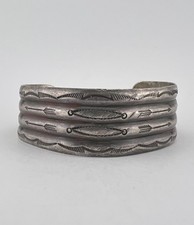
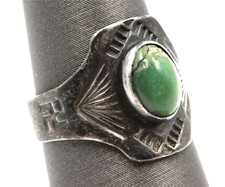
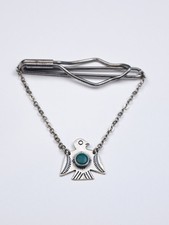
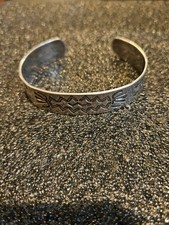
Early Antique Fred Harvey Era Navajo Sterling /Coin Silver Bracelet Whirling Log
Early Antique Fred Harvey Era Navajo Sterling /Coin Silver Bracelet Whirling Log
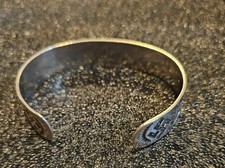
The Whirling Log motif symbol on the cuff is known as the “whirling log” (or tsil no’oli’) to the Navajo (Diné) people, is a sacred emblem representing well-being, good luck, and protection. Believed to be an Early Antique “Fred Harvey Era” Sterling or Coin Silver. 925 or. 900.
Condition: Pre-Owned
Price: USD 365.00
Seller: madhouse-co (100.0% positive feedback, 43 reviews)
View this Fred Harvey item on eBay
Item Description from Seller
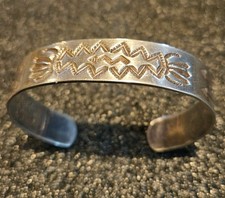
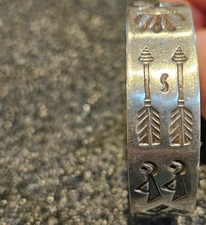
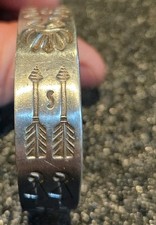
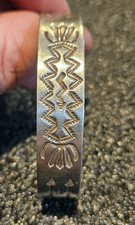
Center image: features a Native American design motif, specifically a zigzag pattern often associated with lightning or water.
Lightning/Water Motif: The jagged, zigzag lines are frequently interpreted as symbolizing lightning, which represents power, speed, and transformation in many Native American cultures.
Mountain/Life Path Motif: In other interpretations, particularly among some Southwestern tribes, the zigzag pattern can represent mountain ranges or the twists and turns of life’s journey.
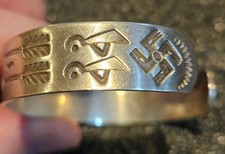
Thunderbird Feathers: The fan-like symbols on the ends could be stylized feathers, possibly relating to the Thunderbird, a powerful spirit figure in many indigenous traditions.
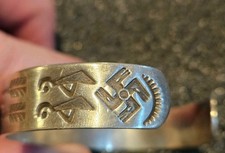
The arrow motif: is a significant symbol in Native American culture, often representing protection, defense, direction, or force.
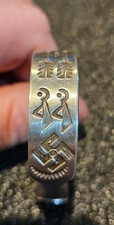
The Whirling Log motif symbol on the cuff is known as the “whirling log” (or tsil no’oli’) to the Navajo (Diné) people, is a sacred emblem representing well-being, good luck, and protection. It is distinct in origin and meaning from the Nazi swastika, which co-opted the symbol in the 1920s and is typically angled like a diamond.
Meaning and History:
Ancient Symbol: The motif is an ancient symbol found in many cultures across the world dating back thousands of years.
Navajo Legend: In Navajo culture, the whirling log relates to a creation story where a hero, an outcast from his tribe, receives ceremonial knowledge and healing skills during a journey down a river in a hollowed-out log, aided by deities.
Pre-WWII Use: Native American artists, especially in the Southwest, used the whirling log in weavings, jewelry, and basketry between the late 1800s and 1940 as a positive symbol.